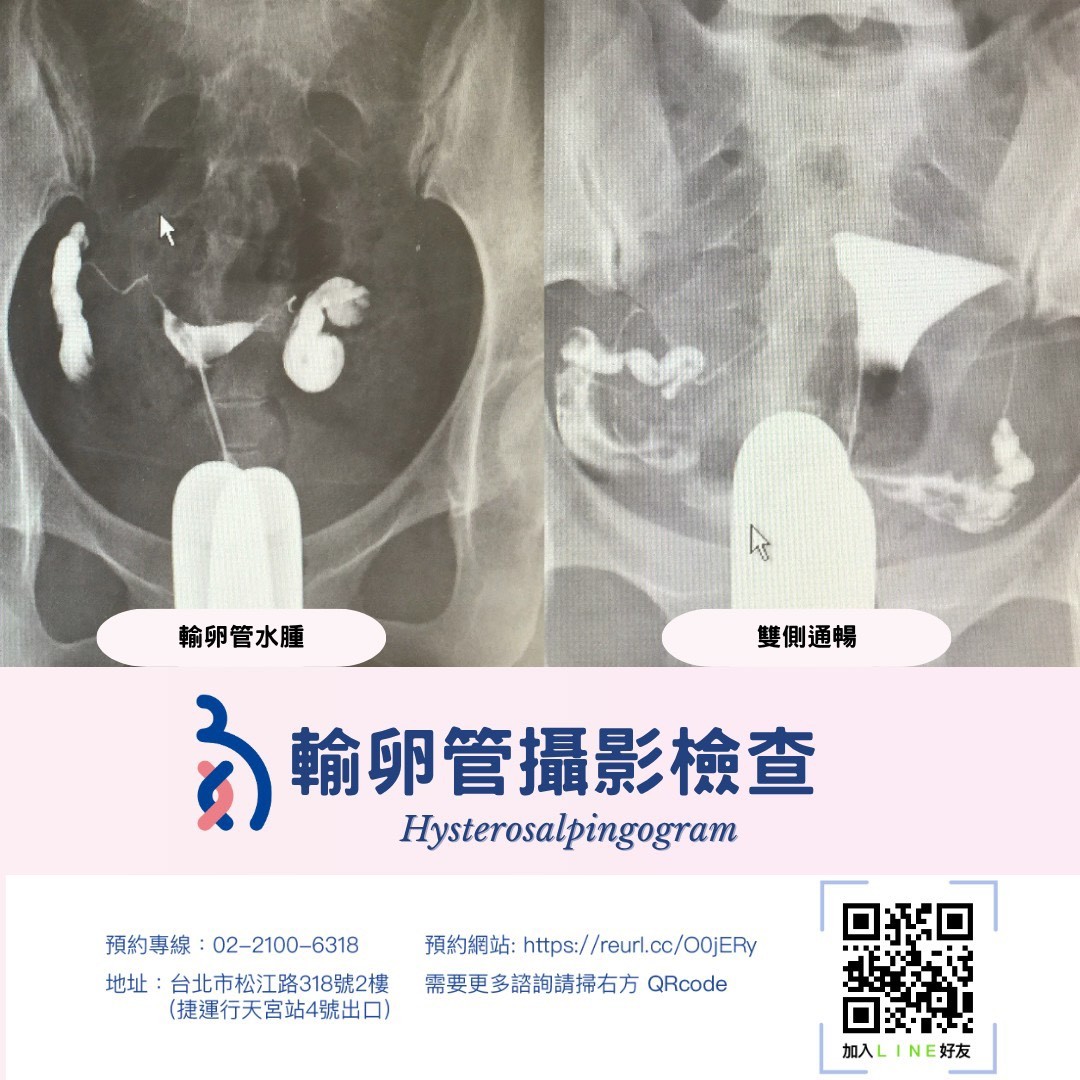
What Is a Hysterosalpingography, HSG, Test? 🧐
Hysterosalpingography, or HSG, is performed by injecting contrast dye through the vagina and cervix into the uterine cavity, followed by X-ray imaging.
The exam observes whether the contrast dye flows from the uterine cavity through the fallopian tubes and then spreads into the pelvic cavity.
This can help determine whether the fallopian tubes are blocked or swollen with fluid, whether the uterus has structural abnormalities, and whether there are adhesions, polyps, or compression-related deformities inside the uterine cavity.
For some young couples after marriage, one difficult issue is being unable to complete intercourse.
Of course, couples who marry later in life, or couples who have been married for a long time, may also encounter the same problem.
If the male partner’s semen analysis and the female partner’s ovarian function are both normal, and the couple is unable to complete intercourse, IVF may not necessarily be needed right away.
They may first consider trying intrauterine insemination, IUI, but the prerequisite is that the fallopian tubes must be open.
If both fallopian tubes are blocked, IUI will not result in pregnancy.
For women under 35, the chance of pregnancy through IUI is about 14–18%, with an average of around 15%.
As age increases, the success rate decreases.
According to the assisted reproduction analysis report released by Taiwan’s Health Promotion Administration in 2024, the pregnancy rate for frozen embryo transfer in women under 35 was 55.1%.
Compared with IUI, the difference is indeed quite significant.
Whether to proceed with IUI should still be based on semen quality, ovarian function, fallopian tube patency, both partners’ ages, the chance of success, and the time required.
The couple should weigh these factors together before making a decision.
BRCIVF wishes your dreams come true!